
Commercial mindset
Local chip startups will have an easier path to the global market with the creation of a center linking chip design and manufacturing in a process called tape-out.
Semiconductors have been identified as both a foundational industry and a strategic technology, critical to economic growth, national security, and Vietnam’s long-term development. Yet industry experts argue that several structural constraints continue to hold the sector back.
The high cost of design tools and chip tape-out - the process of manufacturing a prototype chip before mass production - has long been one of the biggest barriers to the growth of Vietnam’s semiconductor industry. A new government-backed tape-out support program is expected to remove that bottleneck, giving domestic chip startups a pathway to commercialize “Made in Vietnam” semiconductors for global markets.
Easing the bottleneck
According to Mr. Nguyen Anh Tuan, Director of the National Semiconductor Chip Prototyping Support Center, the industry’s greatest challenge remains its poor domestic capabilities. While Vietnam has successfully attracted foreign semiconductor companies into the global supply chain, the number of local companies capable of designing chips, developing products, and moving up the value chain remains limited. Aside from a handful of companies, such as FPT, VSAP Lab, and several small startups, Vietnam still lacks a strong domestic semiconductor ecosystem.
The priority, he continued, is to help Vietnamese chip companies scale. But the semiconductor industry has exceptionally high barriers to entry. Design software, intellectual property (IP), electronic design automation (EDA) tools, and tape-out all require substantial upfront investment, making it extremely difficult for startups to compete.
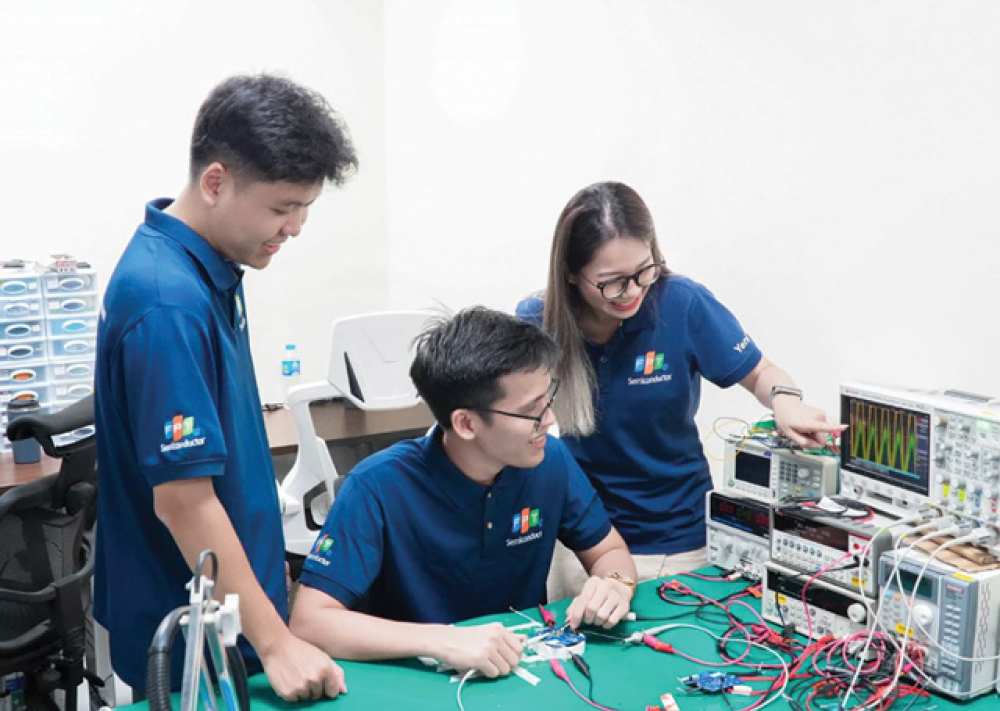
Mr. Tuan argued that the government’s role at this stage is to help domestic companies overcome barriers in technology, cost, and infrastructure. The National Semiconductor Chip Prototyping Support Center was established to act as an industry “incubator,” helping universities and research institutes commercialize research through spin-off companies while providing the tools and resources needed to turn chip designs into working silicon.
On June 26, the Ministry of Science and Technology (MoST) officially launched Vietnam’s first National Semiconductor Chip Tape-out Support Center, marking a strategic step toward strengthening the country’s R&D and prototyping infrastructure, advancing technological self-reliance, and enabling Vietnamese companies to participate more deeply in the global semiconductor value chain.
One of Vietnam’s biggest challenges has been the lack of domestic tape-out capability. Chip developers have had to send designs overseas for fabrication, at costs ranging from $30,000 to $200,000 per design and lead times of 12 to 24 months; a burden that few early-stage startups can afford.
The new Center plans to address this through a multi-project wafer (MPW) model, which combines multiple chip designs on a single fabrication run. The approach significantly reduces tape-out costs and shortens development cycles, accelerating the commercialization of “Made in Vietnam” chips. Under guidance from MoST, the Center will cover 100 per cent of tape-out costs for participating organizations throughout 2026 and 2027.
Between 2028 and 2030, it will continue subsidizing part of tape-out costs while expanding shared laboratories, design tools, testing facilities, and technical services. Beyond 2030, it aims to master advanced semiconductor technologies, strengthen international partnerships, and establish itself as a leading tape-out support center in Southeast Asia.
From prototypes to products
Speaking at the launch, Minister of Science and Technology Vu Hai Quan outlined three key questions facing Vietnam’s semiconductor industry. The first is how Vietnam can continue improving the quality of its semiconductor workforce and turn talent into a national competitive advantage. The second is how Vietnamese companies can move deeper into the global semiconductor value chain. And the third question is which chip products Vietnam should prioritize for investment.
Mr. Nguyen Bao Anh, CEO of VSAP, who has worked with Vietnam’s semiconductor community for two decades, said the establishment of the tape-out Center removes one of the industry’s longest-standing obstacles. “Whenever the semiconductor community talked about building Vietnamese chip startups, the biggest question was always how to tape out a chip,” he said. “If you can’t tape out a design and verify that it works, you can’t bring it to market. And without a product, startups simply don’t have enough capital to survive.”
He emphasized that government support should be driven by market demand rather than technology for its own sake. “Whether it’s edge AI chips, power management chips, or microcontrollers, the key question isn’t what type of chip to build,” he continued. “It’s what type of chip the market actually needs.” With clearly defined commercial demand and coordinated efforts from universities, companies, and startups, he believes Vietnam can build globally-competitive semiconductor products.
Ms. Dang Duy Tra, Deputy Event Director at Informa Markets Vietnam, echoed the importance of commercial thinking. As a global B2B business platform, she argued that every semiconductor strategy must begin with two questions: What are you selling, and who are you selling it to? “Electronics manufacturers generally don’t care how a chip is designed,” she said. “They care about its cost, performance, ease of integration, and how quickly it allows them to bring products to market. Once those questions are answered, Vietnamese suppliers become much more attractive.”
Road to commercialization
Mr. Babak Sabi, former Vice President at Amazon Web Services (AWS) and former Senior Vice President at Intel, believes AI will remain the primary driver of growth for the semiconductor industry, particularly through rising demand for chiplet technologies and advanced packaging. While markets such as wearables and electric vehicles will continue to expand, he said AI applications, including data centers, will generate the strongest demand for advanced chips.
Looking at Vietnam’s opportunities, Mr. Sabi pointed to drones, smart wearables, AI glasses, AI-enabled cameras, and Internet of Things (IoT) devices as promising markets. These applications, fueled by rapid AI adoption, could also help guide the priorities of the National Semiconductor Chip Prototyping Support Center as it determines which chip categories to support.
Ms. Nguyen Thi Bich Yen, Chairwoman of VSAP and Honorary Chair of the Institute of Semiconductors and Advanced Materials at Vietnam National University, Hanoi, said AI is fundamentally reshaping the semiconductor industry. Global demand is growing at an unprecedented pace, driven by AI, data centers, electric vehicles, IoT, supercomputing, and next-generation computing technologies.
She noted that it took more than 60 years for the industry to reach annual revenue of around $500 billion. Today, growth is accelerating much faster. Global semiconductor revenue is already approaching $1 trillion and is projected to reach $1.5-1.6 trillion before the end of the decade.
For developing economies such as Vietnam, Ms. Yen sees such a transformation as a unique opportunity. Building a leading-edge fabrication plant capable of producing chips below 10 nanometers requires tens of billions of dollars in investment and three to five years before production begins. By contrast, an advanced packaging facility requires roughly $1 billion - at least ten-times less - and can begin generating revenue in under three years, making it a far more practical entry point for emerging economies.
To capitalize on this opportunity, she argued that Vietnam should develop an integrated semiconductor ecosystem rather than pursue isolated investment projects. The country’s strategy, she said, should focus on “using short-term gains to finance long-term ambitions” by investing selectively instead of chasing every technology trend.
According to Minister Quan’s assessment, now that Vietnam’s policy framework and basic infrastructure are taking shape, execution has become the industry’s defining challenge. The semiconductor sector, he argued, cannot succeed if research institutes, universities, and businesses continue operating independently, but instead requires close collaboration across the innovation ecosystem.
Source: Huyen Thuong